Talking about paintings
Explore famous artworks, practice describing scenes using the Present Continuous tense, and share your perspective on art.
Let's get started with a warm-up
Choose the words that make the sentences true for you and provide some details below each statement.
Choose the correct option
Singular to Plural
Change the verbs in the sentences into the plural form and make any other necessary changes.
The person is eating an apple.
→ The people are eating apples.
Look at the paintings and discuss
Click any painting to inspect it closely or reveal artist notes.
 1 Click to enlarge
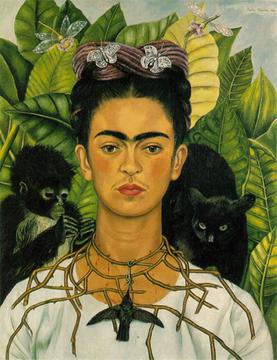
Self-Portrait with Thorn Necklace and Hummingbird (1940)
Artist: Frida Kahlo (Mexican, 1907–1954). Features a black monkey, a black cat, butterflies in her hair, and lush green leaves behind her.
 2 Click to enlarge
Nichiren Calming the Stormy Sea (c. 1835)
Artist: Utagawa Kuniyoshi (Japanese ukiyo-e master, 1798–1861). Depicts the Buddhist monk Nichiren calming huge blue ocean waves from a small boat.
 3 Click to enlarge
Luncheon of the Boating Party (1881)
Artist: Pierre-Auguste Renoir (French Impressionist, 1841–1919). Shows Renoir's friends relaxing, chatting, holding a small dog, and sharing drinks on a sunlit balcony along the Seine river.
 4 Click to enlarge
The Hunters in the Snow (1565)
Artist: Pieter Bruegel the Elder (Netherlandish Renaissance, c. 1525–1569). Three hunters walk through deep snow with their dogs while villagers ice-skate on frozen ponds in the valley below.
Discussion Questions (Click to check off as you discuss)
- ✓ Have you seen the paintings before? What do you know about them and the artists who painted them?
- ✓ How does each painting make you feel? Why do you think it makes you feel that way?
- ✓ What are the people (and animals) in the paintings doing? (Use Present Continuous!)
- ✓ What do you think may happen next in each scene?
- ✓ Would you like to hang any of the paintings on the wall at home? If so, which one? If not, why not?
Listen and imagine two paintings
Listen to descriptions of two paintings and try to imagine them. Then, say which painting you think you would like more and why.
"In the first painting, it's night and we are looking at a street in a town. On the left, there is a café with a big yellow light. A few people are sitting outside at small round tables, drinking coffee and talking. A waiter is standing near them. On the right, there are dark houses, and above the street, the dark blue sky is full of bright stars."
Artwork: Vincent van Gogh — Café Terrace at Night (1888)
"In the second painting, it's a sunny afternoon in a green park by a river. Lots of people are relaxing on the grass under the trees. Some women are holding parasols, a man is smoking a pipe, and two dogs are playing in the foreground. On the water, people are sailing and rowing boats."
Artwork: Georges Seurat — A Sunday on La Grande Jatte (1884)
Describe & Imagine Paintings
Work in pairs. You are going to get a card with images of two paintings. Do the tasks below.

Prompts: Dark room • 5 people sitting around a small table • eating potatoes • pouring hot drink • serious faces
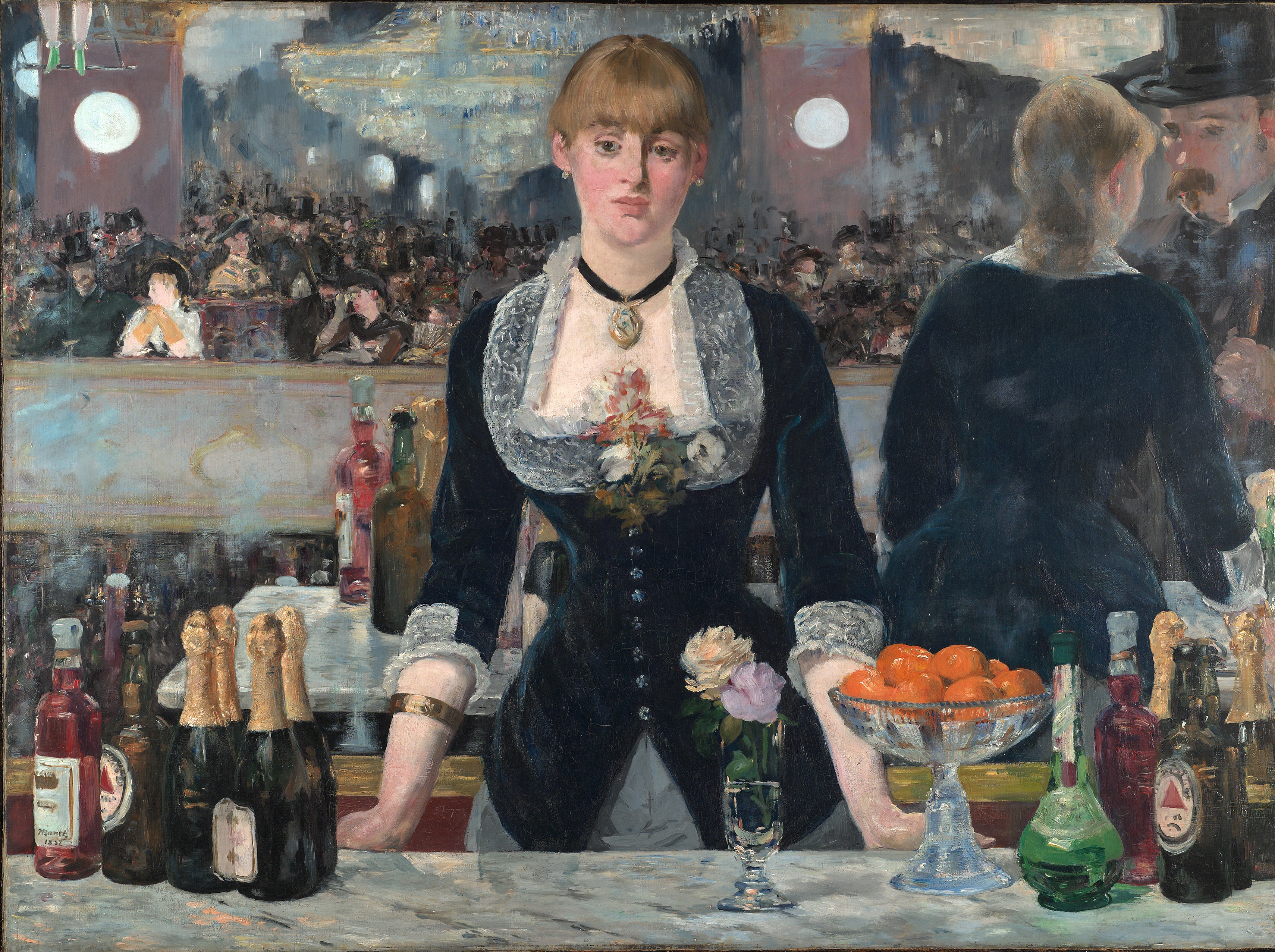
Prompts: Young woman standing behind a counter • bottles & fruit • big mirror behind her • crowd talking in the background

Prompts: One woman standing in a quiet room • pouring milk into a bowl • bread on the table • light coming through a window

Prompts: Many people outside under trees • couples dancing • friends sitting at tables and smiling • wearing hats
What would you do in each situation?
For each situation (A–D), choose the option you prefer (1–2) and give more details. Then, think of more possible options for each situation.
When classic paintings come to life
When classic paintings come to life through the AI
Watch the video in which classic paintings come to life, then discuss the questions below.
Discuss the questions (Click to mark discussed)
- ✓ Do you think making videos like this one is a good idea? Why/Why not?
- ✓ Did you recognize any paintings in the video?
- ✓ Does watching the video make you feel differently about the paintings?
- ✓ Is there a painting that you would like to see coming to life? If so, which one?
- ✓ Do you think people today are less interested in art than in the past? Why do you think so?
- ✓ How important is it to learn about art and art history?
- ✓ What can people do to get others (adults and/or children) more interested in art and in art history?
Create a painting of your life
Imagine you want to create a painting to show your life and the lives of people around you. Choose one title in the boxes and say what the people in the painting are doing. Add any other details you think are important.